Wildfire risk changes constantly.
Does your data?

Wildfire Hazard Data at 30-meter resolution — updated annually to reflect changing vegetation, climate, and land use. Built on peer-reviewed science. Trusted by insurers, utilities, and land managers across Canada.

See Coverage Map
30-Meter Resolution
Built on Peer-Reviewed Science
Annual Updates
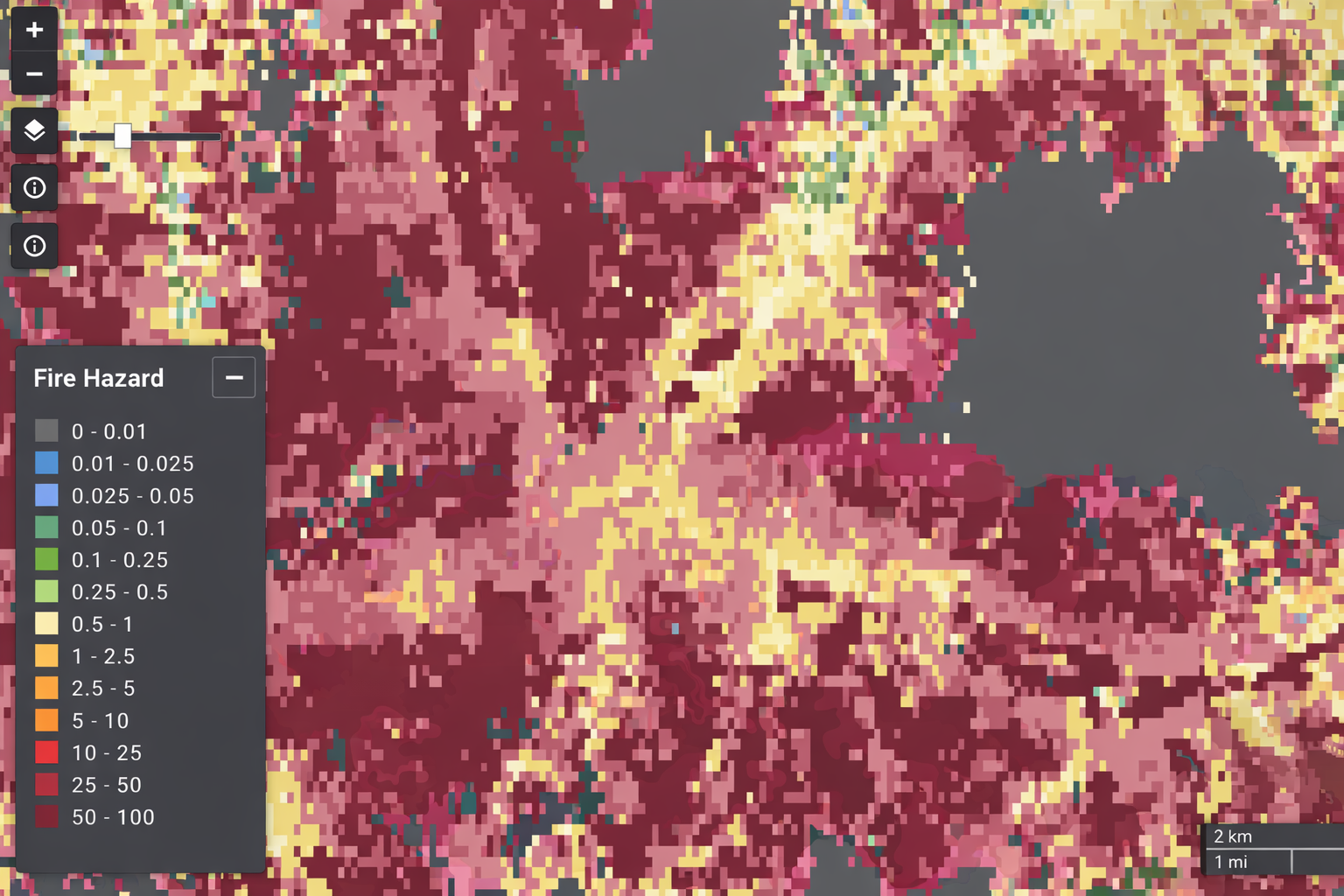
Wildfire Hazard Data — 30-meter resolution example

Built using BurnP3+ on data from

The Cost of Outdated Fire Risk Data

$1B+
Annual wildfire suppression costs in Canada1
2.5M ha
Hectares of forest burned annually in Canada on average2
18.5M ha
Burned in the record-breaking 2023 fire season alone3

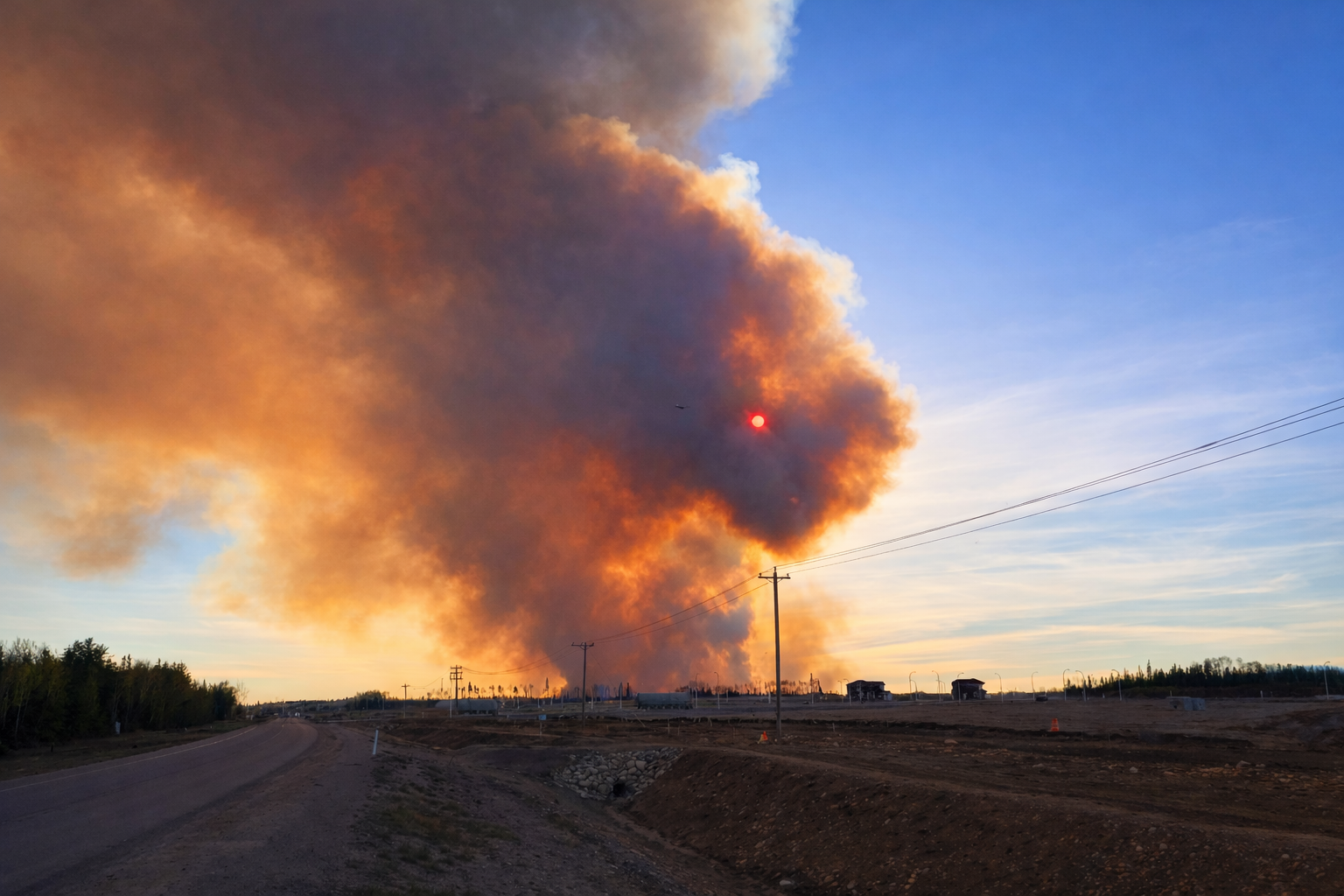
In 2016, a single wildfire destroyed 2,400 homes in Fort McMurray, Alberta — causing a record $3.7 billion CAD in insurable losses. Across Canada, 1.9 million buildings are directly exposed to wildfire, and 13 million people live in wildfire-prone areas.45 Static risk maps and outdated assessments leave all of them exposed. Your wildfire hazard data should keep pace with the risk landscape.

Wildfire Hazard Data: Built for Decisions

Wildfire Hazard Data delivers continuously-updated fire risk intelligence at 30-meter resolution across Canada, built on peer-reviewed science. From utility corridors to insurance portfolios, make confident decisions with data you can trust.

Science-Based Methodology

Built on published, peer-reviewed science with transparent, reproducible methods. Defensible data you can explain to stakeholders.

30-Meter Resolution

Building-scale precision for accurate risk assessment and targeted action. See individual structures and neighbourhoods, not broad regional averages.

Annual Updates

Reflects latest vegetation, climate, and land use changes. Your data stays current as conditions evolve.

Flexible Delivery

Access via web browser, GeoTIFF download, or API integration. Fits your existing workflows and systems.

Solutions for Your Industry

Price risk with precision, not proxies

Coarse-resolution wildfire models miss property-level variation, leading to mispriced policies and unexpected loss ratios. Wildfire Hazard Data delivers the granularity needed for accurate underwriting and portfolio management.

  • Individual property risk scoring
  • Portfolio risk aggregation and mapping
  • Renewal pricing adjustments
  • Catastrophe model inputs
  • Reinsurance documentation
Insurance & Underwriting wildfire visualization

Protect assets and infrastructure before the threat arrives

Wildfire risk from vegetation contact threatens grid reliability, triggers PSPS events, and creates regulatory exposure. Pipeline networks, telecom facilities, and transportation corridors face the same growing threat. Wildfire Hazard Data enables proactive risk management and defensible compliance documentation across your entire asset footprint.

  • Transmission corridor risk assessment
  • Vegetation management prioritization
  • PSPS planning and documentation
  • Pipeline and right-of-way risk assessment
  • Emergency response and maintenance prioritization
Utilities & Critical Infrastructure wildfire visualization

Protect timber value and plan with confidence

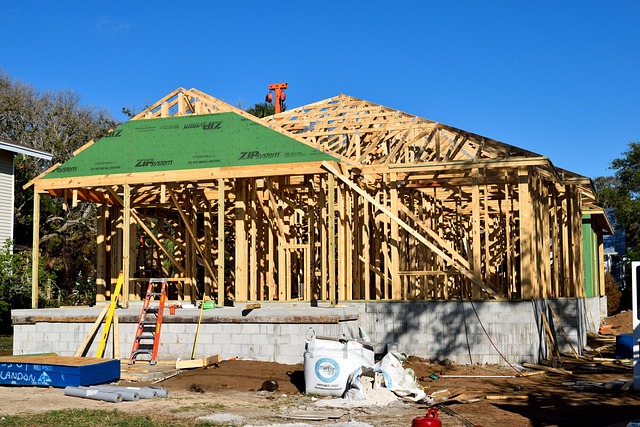
Wildfires threaten timber investments, carbon credits, and decades of forest management. Wildfire Hazard Data enables prioritized resource allocation, strategic harvest planning, and informed prescribed burn decisions.

  • Timber asset protection planning
  • Prescribed burn prioritization
  • Reforestation site selection
  • Carbon credit risk assessment
  • Fuel treatment planning
Forestry & Land Management wildfire visualization

Plan with confidence for the communities and lands you steward

Municipal, provincial, and Indigenous governments need credible, high-resolution wildfire risk data to inform zoning, forest management, conservation, and community safety planning. Wildfire Hazard Data provides the science-based foundation for defensible decisions at every level of government.

  • Zoning and land-use planning in wildfire-prone areas
  • Community Wildfire Protection Plan (CWPP) development
  • Forest management and conservation prioritization
  • Indigenous territory and cultural site protection planning
  • Emergency preparedness and evacuation planning
Government & Community Planning wildfire visualization
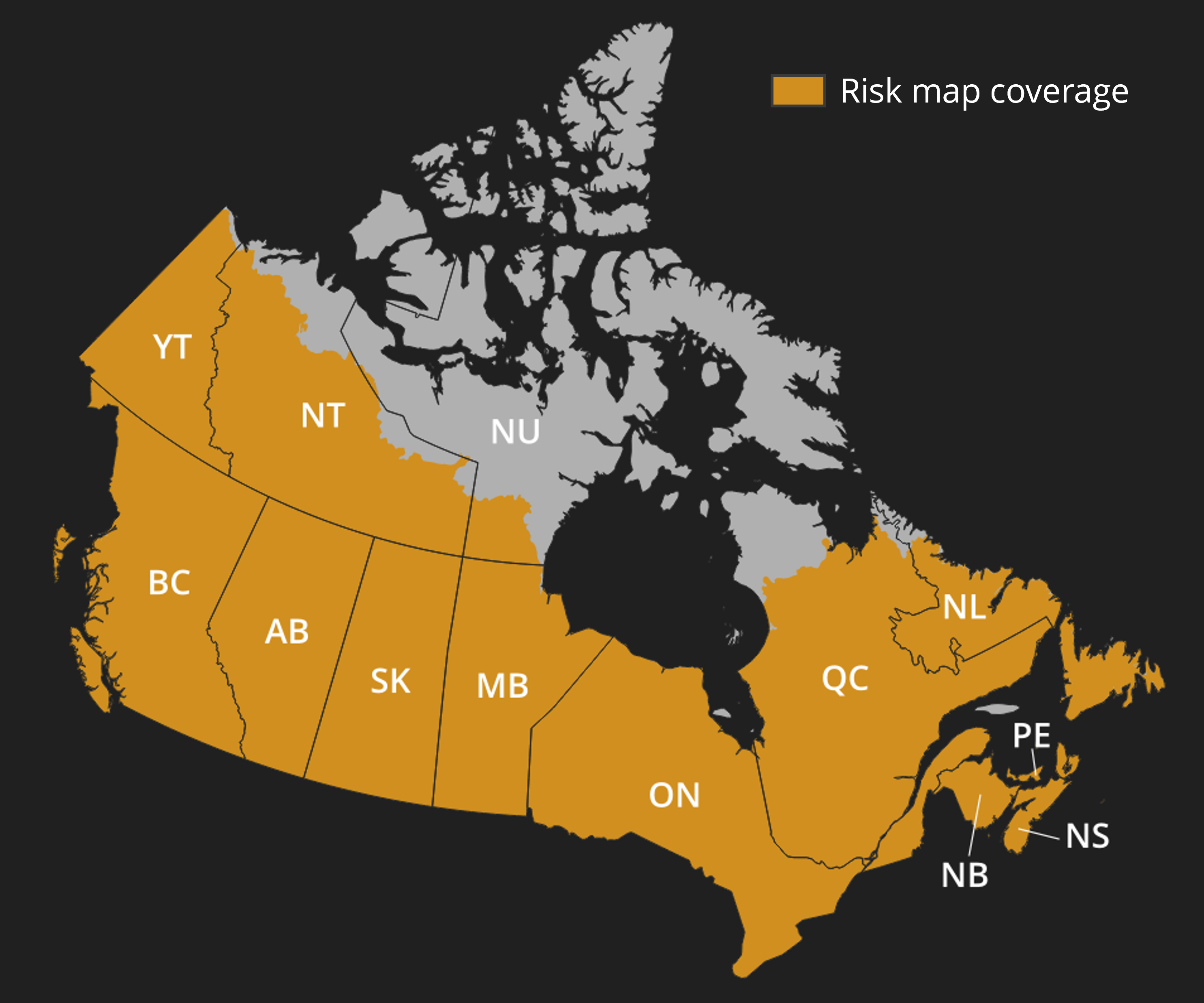
Fire Hazard coverage map — all of Canada except Nunavut and the northern tip of Quebec

Wildfire Hazard Extent

Our data covers virtually all of Canada's wildfire-prone landscapes — every province, the Yukon, and the Northwest Territories.

~98% of Canada's population
13M Canadians living in wildfire-prone areas
1.9M buildings directly exposed to wildfire
  • Spans the entire Canadian boreal forest, the world's largest intact forest ecosystem, covering ~552 million hectares
  • Covers all major wildfire-prone ecozones: Boreal Shield, Montane Cordillera, Prairies, Taiga Plains, and Atlantic Maritime
  • Includes virtually all of Canada's ~347 million hectares of forest — 9% of the world's total forest cover

How It Works

1

Choose Your Coverage

Select your geographic area of interest from our Canada coverage map

2

Access Your Data

Access via web browser, download GeoTIFF files, or integrate via API

3

Act on Insights

Prioritize maintenance, underwrite accurately, or plan fuel treatments

Data Delivery Options

Web Browser

Explore data interactively in any browser without software installation

GeoTIFF Download

Download standard files for use in ArcGIS, QGIS, or custom applications

REST API

Direct integration into underwriting systems, dashboards, or workflows

Why Wildfire Hazard Data?

See how Wildfire Hazard Data compares to alternatives

Recommended Wildfire Hazard Data Generic Wildfire Maps In-House Analysis
30-Meter Resolution 250m–1km Varies
Annual Updates Static Rarely
Peer-Reviewed Science
Canada-Wide Coverage Often regional Limited
Multiple Delivery Formats Single format Varies
Defensible Methodology
Ready in Days Weeks+ Months+

Frequently Asked Questions

Getting Started

How quickly can we get access to the data?

Most customers receive access within 1-2 business days of completing their agreement. Enterprise integrations may require additional setup time.

Can I evaluate the data before purchasing?

Yes. We offer sample data downloads and demos to help you evaluate fit. Contact us to request access.

What geographic coverage is available?

Wildfire Hazard Data currently covers Canada. Coverage is expanding; contact us about specific regions.

Technical

What is the data resolution?

Wildfire Hazard Data is provided at 30-meter resolution, enabling building-scale risk assessment.

How often is the data updated?

Data is updated annually to reflect changes in vegetation, climate patterns, and land use.

What formats are available?

Data is available via web browser, GeoTIFF download, and REST API. Enterprise customers can request custom formats.

How does Wildfire Hazard Data integrate with GIS software?

GeoTIFF files work natively with all major GIS platforms including ArcGIS, QGIS, and Google Earth Engine.

Methodology

How is wildfire hazard calculated?

Our methodology combines vegetation type, topography, climate data, and historical fire patterns. It is built on peer-reviewed science and NRCan's established fire modelling methods (Burn-P3+).

Is the methodology validated?

Yes. Our methods are built on peer-reviewed scientific literature and NRCan's validated fire modelling framework. We also conduct ongoing validation against observed fire behavior.

Business

What are the licensing terms?

Licensing is typically annual and based on coverage area and delivery method. Enterprise agreements offer custom terms.

Can multiple team members access the data?

Yes. All plans support multiple users within your organization. Enterprise plans offer unlimited seats.

  1. Hope, E.S. et al. (2016). Wildfire Suppression Costs for Canada under a Changing Climate. PLOS ONE, 11(8), e0157425.
  2. Hanes, C.C. et al. (2019). Fire-regime changes in Canada over the last half century. Canadian Journal of Forest Research.
  3. Natural Resources Canada (2023). Canada's record-breaking wildfires in 2023: A fiery wake-up call.
  4. Wotton, B.M. et al. (2017). Potential climate change impacts on fire intensity and key wildfire suppression thresholds in Canada. Environmental Research Letters. van der Werf, G.R. et al. (2017). Global fire emissions estimates during 1997–2016. Earth System Science Data.
  5. Erni, S. et al. (2023). Mapping wildfire hazard, vulnerability, and risk to Canadian communities. International Journal of Disaster Risk Reduction.

Wildfire Risk Isn't Waiting.
Neither Should You.

Get high-resolution, current, and credible wildfire hazard data today.

Contact Us